

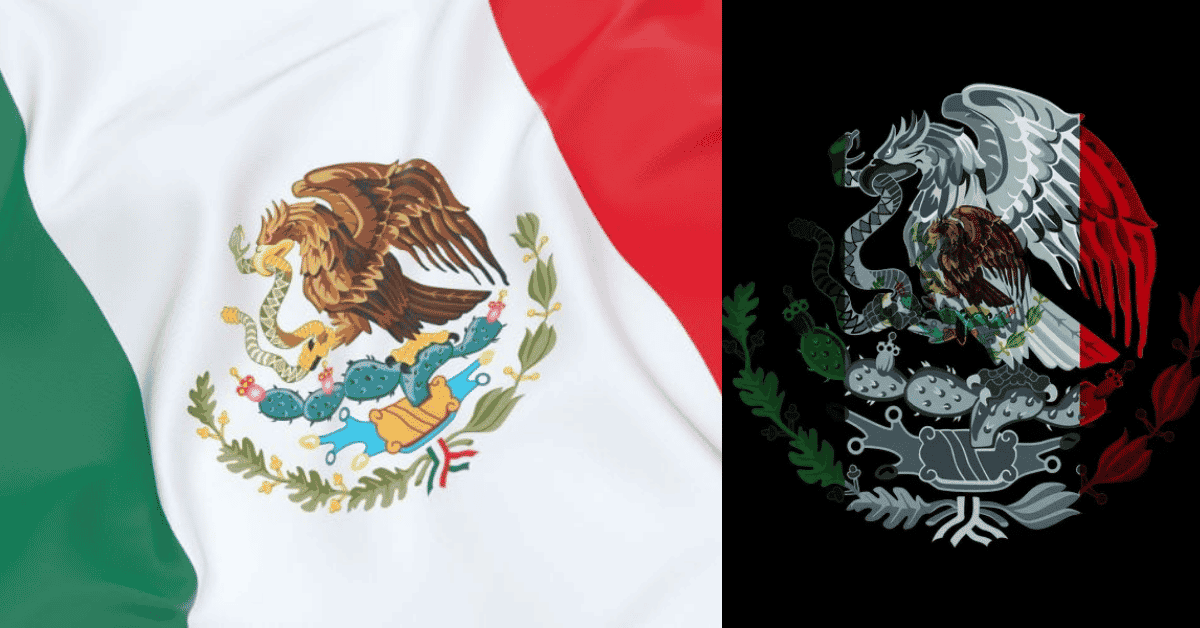
Here’s something funny. You’ve probably seen the Mexican flag a thousand times over a taquería, painted on a face at a parade, waving at a soccer game, tucked into a text as a tiny emoji and never once stopped to actually look at it. I was the same. Then someone told me what that little eagle is doing up there, and honestly, I’ve never seen the thing the same way since. There’s a 700-year-old story crammed into those three stripes. So grab a coffee, and let’s pull it apart.
A Quick Look at the Mexican Flag
First, the lay of the land. The Mexican flag is a vertical tricolor three equal stripes running top to bottom, green then white then red. Dead center, in the white band, sits the national coat of arms: a golden eagle on a cactus, a snake in its grip. The official proportions are 4:7, so it’s a bit wider than the flag you’re probably picturing in your head.
Now, plenty of countries do vertical stripes. That’s not what makes the mexican flag special. It’s that emblem. Most nations keep their flags nice and abstract a stripe here, a star there. Mexico said no thanks and dropped an entire founding myth right into the middle of theirs. We’ll get to that. It’s the good part.
What the Mexican Flag Colors Really Mean
Okay, this one surprised me. The mexican flag colors haven’t always meant what they mean now.
Rewind to 1821, fresh off independence. Back then the three colors matched the “Three Guarantees” the young country was built around. Green meant independence. White stood for religion Roman Catholicism, specifically. And red was union, the tie between Mexicans of European and American roots.
Then time did its thing. As the country grew more secular through the 1800s, those meanings got quietly rewritten into something less tied to the church. The version you’ll hear today goes: green for hope, white for unity, red for the blood of the heroes who died fighting for independence. Both readings are “right,” just from different chapters of history. Handy little fact to drop at a dinner party, if you ask me.
The Mexican Flag Eagle: The Legend Behind the Emblem
And now the main event. That mexican flag eagle? It’s not decoration. It’s a prophecy.
The tale belongs to the Mexica people the folks we usually call the Aztecs. As the legend goes, their god Huitzilopochtli gave them a very specific instruction: keep wandering until you spot an eagle perched on a prickly pear cactus, eating a serpent. So they wandered. For years. And then, on a scrubby little island out in Lake Texcoco, there it was exactly the sign they’d been promised. They took it as the green light, settled down, and founded their great city, Tenochtitlán, in 1325. That same spot? It’s Mexico City today.
So when you look at the eagle, you’re staring at the birth of a civilization. The cactus is the island. The eagle is the omen. Folks sometimes read the snake as good beating evil, but the real heart of it is that origin story. Every time the flag goes up a pole, that ancient prophecy gets told all over again no words required.
A Brief History of the Mexican Flag
The flag didn’t show up looking the way it does now. It grew into it.
The first one appeared in 1821, carried by the Army of the Three Guarantees right after Mexico shook off Spanish rule. Over the decades that followed, the design kept shifting with the country’s mood empires, republics, reforms, the whole rollercoaster left marks on it. The eagle especially got reworked more than once. Facing left, facing right. Crowned, then not.
The version most of us know got standardized in 1968, when the coat of arms was given its modern, dignified form. Then in 1984 the whole thing was written into law exact colors, exact proportions, rules for how the flag should be handled. Mexicans even set aside a day for it: Día de la Bandera, Flag Day, every February 24th. That tells you how much this symbol matters down there.
How to Make a Mexican Flag Drawing
Feel like sketching one? A decent mexican flag drawing is more forgiving than it looks, as long as you don’t fumble the basics.
Draw a rectangle, split it into three equal vertical chunks. Green, white, red, left to right. Keep the stripes even uneven bands are the rookie giveaway every single time. The emblem’s the fiddly bit, so here’s how I’d play it:
- Going casual? Boil the eagle down to a simple silhouette on a small green cactus, thin snake, done. Nobody’s grading you.
- Want it accurate? Rough it in pencil first, and treat the eagle, cactus, and snake as three separate shapes before you start fussing with feathers.
- Either way, keep the emblem centered in the white band and about a third of the flag’s height.
The goal is the spirit of it, not perfection. Honestly, even a kid’s crayon version gets the point across.
Using the Mexican Flag Emoji
In the texting era, the mexican flag emoji pulls serious weight. It turns up around Independence Day, all through the World Cup, on Cinco de Mayo posts basically anywhere someone wants to wave a little Mexican pride from their phone. It shows up as the green-white-red tricolor with the eagle, and behind the scenes it’s built from the “MX” country code.
Quick warning, though: people grab the wrong flag all the time. Italy’s flag is also green, white, and red but with no emblem in the middle and slightly different shades. So if you’re posting about tacos and tres leches, make sure you tapped the one with the eagle. Small slip, but it’ll earn you a correction in the replies.
Mexican Flag vs. Italian Flag: Telling Them Apart
Since we’re already here, let’s put this to bed, because it confuses a ton of people. Same three colors, same order that’s the whole problem. But the tell is dead simple. The Mexican flag has that detailed coat of arms front and center; the Italian flag’s middle is just clean white. Mexico’s green also tends to sit a shade deeper. Train your eye to hunt for the eagle, and you’ll never mix them up again.
Frequently Asked Questions
What do the three colors of the Mexican flag mean?
These days: green for hope, white for unity, red for the blood of the nation’s heroes. Back in 1821, they stood for independence, religion, and union.
Why is there an eagle eating a snake on the Mexican flag?
It comes from the Aztec legend behind the founding of Tenochtitlán. An eagle on a cactus eating a serpent was the sign marking where the city now Mexico City should rise.
What are the official proportions of the Mexican flag?
It uses a 4:7 ratio, a little wider than many national flags, with three equal vertical stripes.
How is the Mexican flag different from the Italian flag?
Both use green, white, and red, but the Mexican flag carries the eagle-and-snake emblem in the center while Italy’s middle stays plain white. The shades and proportions are a touch different too.
When is Mexican Flag Day? Mexico celebrates Día de la Bandera Flag Day every year on February 24th.Share
